Who’s top dog now? During past months, true power structures have been revealed and their resilience tested. At the same time, we’ve glimpsed different ways to live, forcing us to re-evaluate what matters. Seen in this new light, the value of our homes, our streets, our cities is being redefined.
In this LabCast, we explore how a shift in power will affect place-making and places in the future. How will our cities be reimagined? Who will reinvent them? What new lines of power will be drawn or shared?
Due to Covid-restrictions, our June 2020 PlaceLabs was in the format of an online LabCast.
Recorded on 3 June 2020, our speakers were:
Meredith Bossin– Director of Engagement at the Waterloo Greenway Conservancy, a wondrous cultural parkland in the heart of Austin, Texas.
Hanna Benihoud – Artist, architect and activist based in London, whose work explores gender and youth.
Ayaz Basrai – Designer, architect and founder of the BusRide studio in Mumbai, who focuses on design that is both speculative and social.
This event was part of the London Festival of Architecture.
We decided to use lockdown as a Pause: as a moment of introspection to reflect on where we came from, and especially as a moment to define where we would like to go.
The futurist Peter Ellyard says, “the future is not a probable place we are being taken to, but a preferred place we are creating.” In this episode, we dream up future homes, commerce and public places.
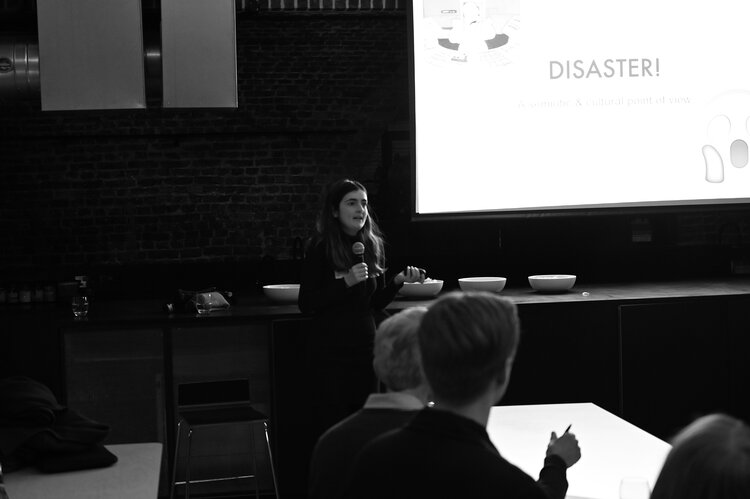
A newly converted warehouse in Wapping, from where JTP’s architects and master-planners design places of the future. According to some forecasts, the area will be submerged by rising sea levels, if the climate continues to warm at our current rate. Relentless rain is flooding parts of Britain. Wildfires have burnt large areas of Australia and the Amazon. Coronavirus, more than causing the biggest-ever drop in stock markets, constrains personal and communal behaviour in public spaces. Forced migration already piles huge pressure on societies that react with lockdown. You’ve guessed it. Our theme for this quarter’s PlaceLabs was “Disaster?”. Ever the optimists, we added a question mark: is this a time of disaster we are living through, and if so what does it mean for us now and for our places in the future?
“Diagnosis”
Our first speaker was Gemma Jones, a cultural strategist, speculative designer and co-founder of the School of Critical Design. Coming from a semiotician’s point of view that stories shape people, their behaviour and their responses to the world, Gemma talked about how meanings of “disaster” have moved from being seen as unpredictable “acts of god” to being man-made. “Hiroshima was a disaster,” she said, “but to the indigenous peoples of the Americas, so was the arrival of Europeans.”
While, to Gemma, “disaster” is the right word to use for the times we are living, our notion of “disaster-ness” needs to be adapted. Climate change is different in that it is a disaster that unfolds on a temporal scale we can’t see. Our usual fight-or-flight response, Gemma argued, wasn’t triggered because we didn’t have anyone or anything to fight, nor anywhere to run to—which left us in a paralysed state.
Noel Moka was our second speaker. A geographer studying anthropogenic change and a trustee at Participatory City, Noel also felt that our attitudes to disaster had changed over the course of history. From the age of Rationalism, he argued, natural catastrophes were no longer mysterious “acts of gods” but the understandable consequences of an event: a volcanic eruption was the result of geological movements; a flood, the result of an imbalance of in vs. outflow. The risk of disaster became calculable, could be observed and predicted to a large extent—and with this grew a belief that technology could prevent disaster. This had led to (Western) societies organising themselves around risk-response, in a process Noel called “reflexive modernisation”: technology and society would react to expected sporadic catastrophes.
However, Noel continued, “many of the current environmental risks are hardly calculable because we do not understand the consequences of our technological progress.” Rather than prevent disaster, this attitude had perpetuated it and created unforeseen events. Problem-solving kept creating new problems, Noel argued, and he traced this faith in technology back to an anthropocentric attitude, an Icarian hubris, that had disconnected us from our environment.
Paddy Loughman, a strategy director who is involved in Extinction Rebellion, added to this diagnosis by giving us facts and predictions that even at a conservative estimate were terrifying. He quoted James Baldwin to invoke courage and responsibility: “not everything that we face can be changed; but nothing can be changed without facing it.” XR’s fire alarm has been ringing long enough, the necessity to limit global warming to +1.5ºC vs. pre-industrial levels is known well enough for us not to reiterate it here. Nevertheless, a number that may have shocked many in a room full of place-makers, was that China had poured more concrete (one of the biggest sources of CO2) in the last three years than the US did throughout the twentieth century. This revealed deep flaws in a growth economy based on construction, but it also gave us an easy place-related solution: to rethink the materials we use. As Paddy said, the ecological crisis is not an incurable disease. “We know what to do, we just have to do it.”
“Treatment” — Mentality Shift
Our three speakers all agreed, a crucial step was to change our relationship to our environment. Paddy reminded us that “we are nature,” that we shared 25% of our genes with trees, that 50% of our genes weren’t human. Ecology, in his words, is not a commodity but our community. Noel similarly suggested adopting a nodal model of place in which the human and the non-human are connected in intricate ways, recognising the agency of all elements.
Changing our response to the “slow apocalypse,” according to Gemma, required us to promote narratives that made people “feel” the current disaster on a sensory, emotional level. This would allow us to tap into the mentality of mutual assistance, of creativity—of humanity—that is seen when large-scale catastrophes occur (like the 2004 tsunami in South-East Asia). To Paddy, this also meant understanding that climate change wasn’t the narrative itself but a setting for all other narratives, always present.
In this respect, we were encouraged to use narratives of the future as speculative design. While Paddy called for us to remember the power of hope and of promise, Gemma quoted Björk and her Cornucopia: “imagine a future … be in it.” In our fight-or-flight response, we need to give ourselves something to run towards. This future, echoing Kate Raworth’s Doughnut Economics, must fundamentally rethink our economy away from pure growth towards a model that factors in ecological ceilings. This, the room agreed, required us to look at value in a different way (“the financial value of ecology would be double global GDP”); to change the metrics we use to measure success in general, and in planning places specifically.
Actions In Place
Gemma’s wish, for instance, was that we thought of “places as spaces to prototype adaptive behaviour—as spaces for us to feel the new ways that we need to live in.” She went on, “what places can do is to create space for people to be that doesn’t require consumption, productivity, growth: that are just about dwelling, communicating.” Noel echoed this: “Places are not products, they are systems. Place-making’s role is to design community.” This is something Participatory City seeks to achieve through the involvement of residents—and we need more of that, to foster both responsibility and, perhaps, accountability.
In many ways, in spite of the gloomy nature of the theme, there was also a sense of optimism in the room; that it was possible to do something about the looming disaster; that “we are the leaders we’ve been waiting for,” as Paddy ended his talk: we have to go beyond pledges and commitments. It is in our hands to make plans for action.
Actions and plans were what we asked of everyone in the audience. One such could be to re-wild the city, which, numbers show, would be 40% more effective at absorbing CO2 than monocultures and lawns. Space for wildness in the city abounds, and residents could take more into their own hands—from rooftops to gardens to public squares.
Many of the plans our audience made centered around professional responsibility and agency. Specifically, they were plans to “Try to hold my boss accountable to his pledge — architects declare” and to “Challenge my own small business to lead by setting an example, challenging our clients and manufacturers.” One participant planned to “Devise new decision filters that at least manifest a fresh awareness,” while another wanted to “Be evidence-based and (…) to push developers and show them that innovation = value.” Such plans will require courage – and we wish them all the strength they need.
Still, many participants also made plans for individual action in their personal lives. These ranged from tangible things like “Invest in a good bike and use it”, “Fly less”, “Holiday at home” and “Create rituals and journeys that don’t involve consuming” to more ambitious mind-shifts: “Think, act and consume more locally (…) and give back to place – place is built by us committing to space.” As several people in the audience wrote, change will require us all to “Speak up, act up, act out of love not fear” but, most of all, “Show up”. We hope this will inspire you, too.
In this, our first episode, we discuss the theme of “Disaster?” — amidst wildfires and floods, the coronavirus outbreak and forced migration, how does Disaster affect our places in the present and the future? Is “disaster” even the right word for our times?
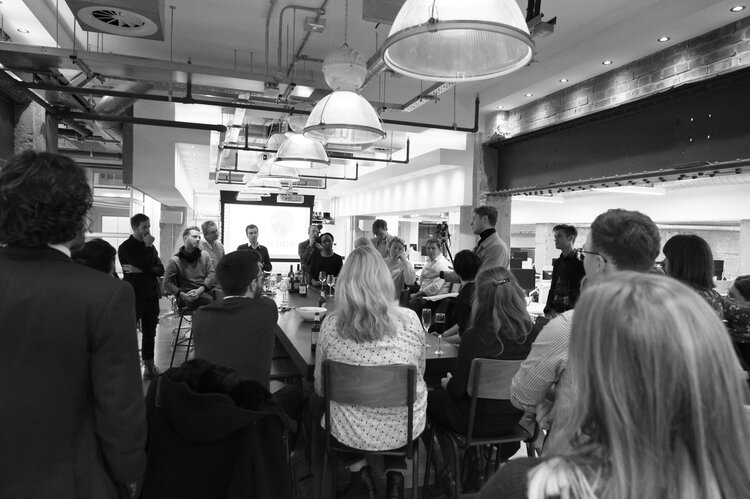
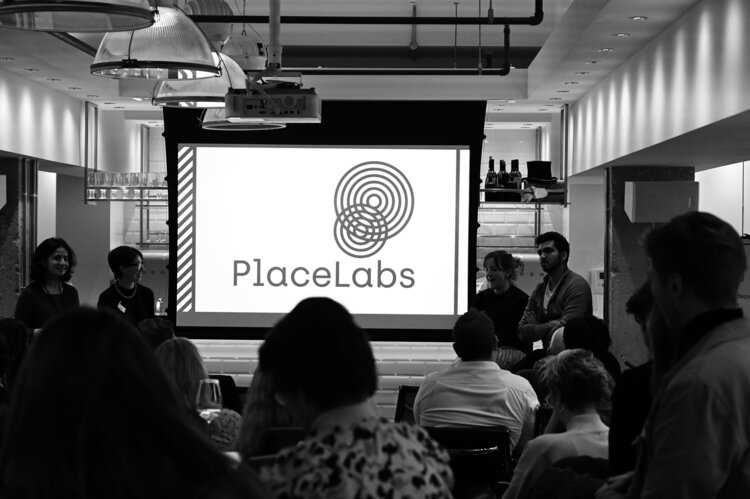
It felt fitting to gather at a repurposed building in central London to discuss the (not always happy) marriage of investment and place. This PlaceLabs event was hosted by Iceni Projects, a multi-skilled consultancy that helps to deliver better places, and whose Farringdon offices are in the lower level of a former car park: the existing architectural fabric worked into the redesign, exposed pipes mixed with sleek furniture, and a lovely colour scheme focused on a spring-leaf green fridge to breathe new life into a forgotten space.
Investment, then. Nothing less. Our tacitly agreed starting point was that capital investment was necessary to drive development, hence social value also needed to be commercially viable. This, of course, opened up questions like what is social value, whose social value do we mean and indeed who defines it?
Michael Cowdy of McGregor Coxall
Defining social value
Our first two speakers, using different examples from their own practice, gave their view on this. Michael Cowdy of McGregor Coxall suggested that, as opposed to other industries, “historically, the urban world hasn’t used usage statistics as a platform for delivering social benefit.” He exemplified this with a pedestrian shopping mall in Sydney that had fallen out of use, was no longer fit for the demographic and behavioural shift that had occurred. More important to Michael, however, was the requirement to consider places’ impact more holistically: that is, considering the city-wide context, include (and use) forgotten spaces such as alleyways, and understand the interconnectedness of all elements (say, how the redevelopment of an urban marshland can affect the habitat of migratory birds).
Smart cities and data, gathered through new technologies, can give a sense of social value, but Stephanie Edwards’s practice, Urban Symbiotics, adopted a more research-and-interview based approach to understand what the social value of a particular place might be. “As designers and architects,” she said, “we thought we knew what users needed … but we didn’t.” In dialogue with “users,” (for example, in Kensington & Chelsea where they were tasked to design a 21st century estate) she found that young people felt ignored from considerations and powerless to effect change. “These places that had been designed,” Stephanie said, “were actually threatening to them; people described the places as ‘dangerous’.” Stephanie wondered whether “we were designing out the people we were supposed to design for.” She urged us all to become more self-reflective, aware of possible (unconscious) bias, and to put the users and their real needs at the core of every decision – from design to investment – which is how a place gains its social value.
Stephanie Edwards
From social to commercial value
Stephanie also showed how a user-centric approach could increase commercial value. In her example, the developers of a student accommodation building she worked on had one goal: to maximise occupancy. Stephanie suggested on-going participation by having students sit on a kind of board, empowering them to have an impact on the design and continuous re-design. It must be remembered that, as Stephanie said, “current needs aren’t future needs.” The social value of a place depends on its flexibility and ability to adapt to its community, which in turn leads to long-term commercial value.
Bethan Harris & Zahoor Rahimtoola
Quantifying social value
The inherent problem is that social value is alwaZahoor Rahimtoolays a risk factor, which is at odds with capital investment — at least in current models. As Zahoor Rahimtoola, an impact entrepreneur at Barclays, pointed out, “anything we do has to make commercial sense. We have to make senior executives understand the [commercial] value of helping people live better lives.” This would, in the long term, require a fundamental shift in mindset (like mortgage lenders understanding that they are really in the business of helping people to start families build a home for their family), as well as a new set of metrics by which we measure success (such as including Quality of Life in indexes). In the short term, however, this means driving impact through business. First, it involves quantifying social value, as Michael Cowdy did, for example, using big data and statistics to measure how green spaces per capita reduce health costs. Second, Zahoor said, experimentation had to be conducted on a small scale so as to de-risk it financially, making it “very hard for decision makers to say no to trying it.”
Bethan Harris, of Collectively, observed that “corporates [developers] are good at spending a lot of money on an agency’s idea and pushing it through, […] then they find out it doesn’t actually work.” In her view, small-scale, piecemeal projects and labs offered an alternative. In cooperation with Lendlease, she runs the Loneliness Lab to test ideas for tackling loneliness in London. They are individual projects whose impact can be observed more directly. The arguably greater advantage of this method: labs are cheap, there is hardly any financial risk involved: a strong argument to spark the necessary mindset shift.
David Barrie
Delivering socially valuable places
All this pointed at another question: to whom do we look for investment? Perhaps small-scale experimentation and community-based projects are more easily driven by entrepreneurs, rather than the real estate industry. Here, David Barrie gave us ideas for alternative sources of funds and investment models. From the combination of public and private money, via sequential investment (where several bodies build on work sequentially), to local crowdfunding and Angel Investors’ clubs that screen for local benefit. More importantly, David felt it was possible to harness skills and talent more effectively. This could take the form of “sweat equity,” where people give time and effort in exchange for goods (like the People’s Supermarket), to looking at “franchise equity,” that is tapping into the skills of otherwise hidden communities like video game players.
As so often at the PlaceLabs, the engaging roundtable conversation that followed the talks raised more questions than it gave answers – and rightly so. This was where ideas and examples flowed freely, where thinking was done aloud, where the diversity of perspectives on the subject led to insight, where controversy could be fruitful. For instance, when the PlaceLabs’ Payal Wadhwa suggested that “gentrification is a good thing […] but it depends who delivers it.”
Perhaps, if it were possible to sum up, we might also consider the dangers of “fetishising” social value, turn away from ideas of “fully designed” (even with the best intentions) and remember that what drives place is often immaterial: it is the people. The goal of placemaking might be working towards a more empowering culture. Investment, then, comes down to each and every one of us: from businesses showing their “social licence to operate,” as Jake Heitland from Lendlease suggested during our roundtable conversation — “we have to make a profit, of course, but we must show that we’re here to do good” — via small entrepreneurs, lab runners and non-profits, all the way down to ourselves, as individuals, as residents, as users of place.
Rosanna Vitiello of PlaceLabs with Cat Le Huy, Hideki Yoshimoto, and Jenny Jones
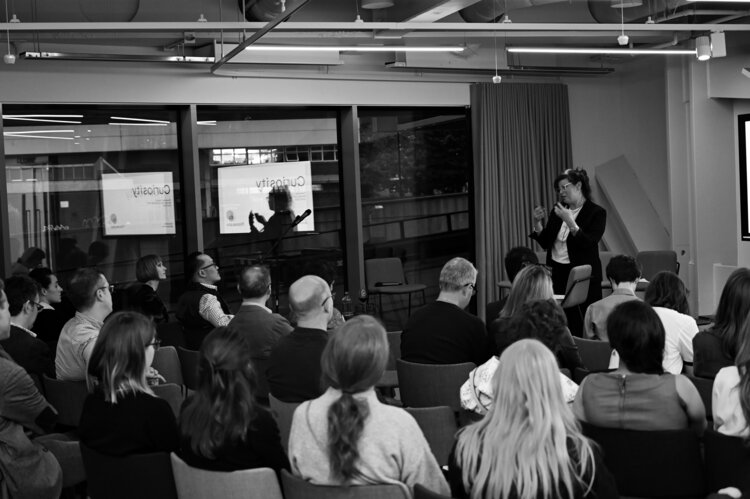
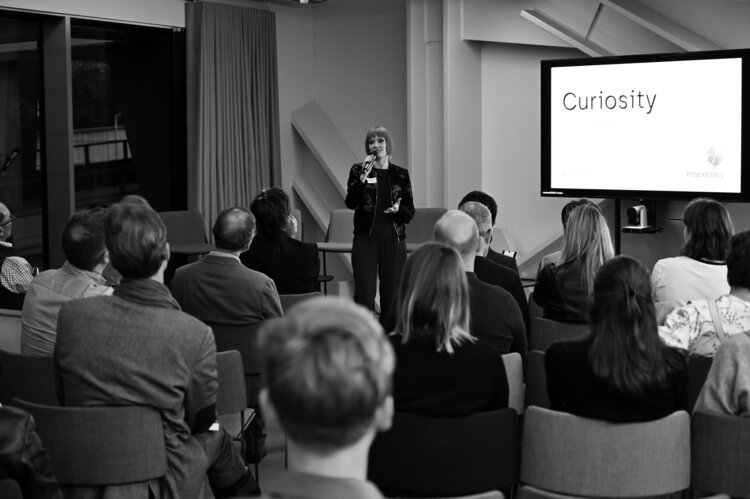
Walking across British Land’s Paddington Central takes you from the train station, along the canal, past the amphitheatre, through a relaxing greenway amidst the growing campus development and, eventually, to the newly-opened Storey Club. Those with a better sense of direction than this writer may have suspected they’d be beside the Westway Flyover. Still, many will have been surprised at the empty view, the eerie quiet: the thoroughfare, normally draining London of cars at this hour, were closed. This unexpected juxtaposition of a Rut Blees Luxemburg urbanscape with active placemaking was where our nomadic PlaceLabs forum pitched up, and whither we beckoned the talented and the curious.
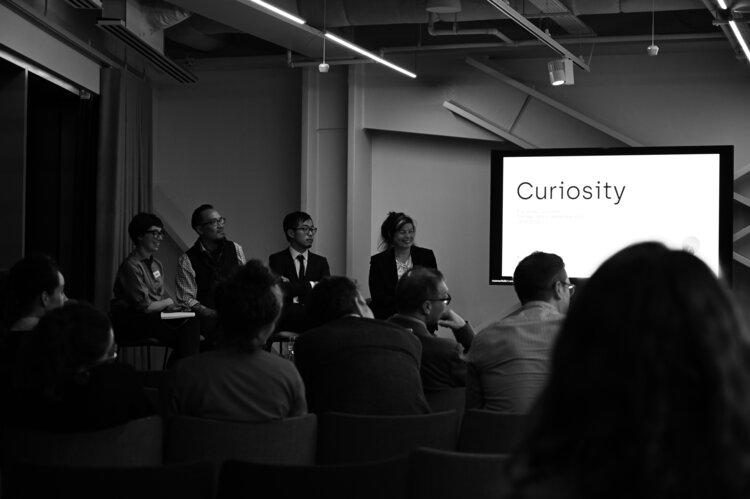
The theme was Curiosity. The question: how can we design places that keep curiosity alive? The speakers, a curious cast of characters — or should that be a cast of curious characters? — eluded clear categorisation but certainly stimulated the mind.
Jenny Jones of Studio Jenny Jones
Kickstarting the familiar format of three PechaKucha-inspired presentations followed by an open discussion was architect Jenny Jones. For Jenny, curiosity equals questions and questions form the core of what she calls her “socratic approach to innovation.” No presupposition remains unchallenged by her why-how-what: going as far as ignoring the brief for a sports centre because her team’s analysis concluded an open park best fitted the needs of that particular project for that particular community. This idea of feeding intuition with analysis formed the core of Jenny’s talk.
Hideki Yoshimoto of Tangent
Next up was Hideki Yoshimoto of Tangent. A background in aero-astro engineering and behavioural AI is not what you’d expect of a designer and installation artist. While Hideki’s approach to design is steeped in technology and motion, his ideas come from a place of curiosity. “Hideki, you must stop thinking and feel,” his professor advised him when he tried to break a creative block. It prompted Hideki to do “literally a hundred experiments” in his studio. However, it is perhaps his company’s name that holds the key to Hideki’s curiosity: allowing himself to go off on tangents, to let stories and folk tales penetrate his thoughts, to leave space for silliness. Looking at swaying rice plants and seeing a design for lights; watching the morning’s first gondola stir up mud in Venice’s Grand Canal and capturing the movement in glass; blowing air through a straw into a jar of honey and converting the viscose bubbles into a coffee table design.
Here Hideki seemed to echo Jenny Jones’s mantra that placemaking should capture “that feeling we have from really looking,” consider the sensory impact of a space, and “choreograph the unedited,” which we took to mean something akin to guiding the senses loosely so as to foster imagination with subtle prompts. Allow people to roam physically and mentally. Our third speaker would take this idea even further.
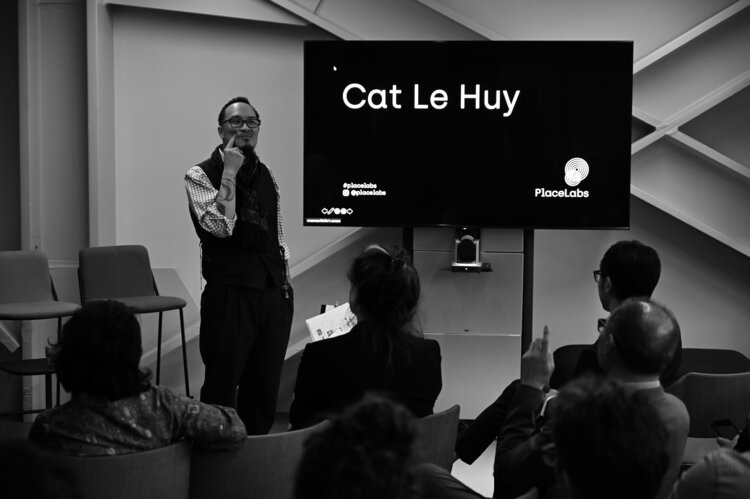
Cat Le Huy
Cat Le Huy was introduced as the “wild card speaker, a technologist, lay-buddhist priest and catholic priest-in-training,” and he chose to look at the design of sacred places. Acknowledging that, historically, places of worship had also been built with dogmatic control and power politics in mind, Cat urged us to “draw the positive out of spiritualism.” Gothic cathedrals, rococo churches, Hindu palaces, he said, were designed to be uplifting, to provoke awe and to feel the divinity in and around us. Nowadays, in a time of widespread literacy and democracy, the aim of such places — here he showed us an image of the light, warmth and openness of Thorncrown Chapel in Arkansas — was to elicit engagement with the self, playful contemplation, bring us to embrace “the divine aspects within ourselves.”
What seemed to unite our speakers was the idea that places which keep curiosity alive make the gift of space (as opposed to shaping it). The move must be away from top-down and towards bottom-up: in short, nothing new but worthy of repeating, putting humans (the people, the inhabitants, the users) at the centre of our design process. As Cat said, “community defines the needs of the built environment.”
One of the needs that emerged in discussion was to have space for ennui (the mother of inventiveness) or idleness, for child-like silliness; and PlaceLabs’s Payal Wadhwa reminded us of so-called “evolving spaces” such as Assemble’s Brutalist playground and New Addington Sq in Croydon, that took their final shape from observing how children used the space: bottom-up design in action!
Further thoughts, briefly mentioned but left quivering for lack of time, included taking ‘curious’ in its other sense of ‘strange, unfamiliar,’ and incorporating surprise. Another one was to adopt a literary editor’s approach of ‘killing your darlings’ — which echoed a previous PlaceLab theme, “Trust”: trust in the users and trust in the clients.
For, as always when idealism is confronted with pragmatism, the two inevitable questions arose: firstly, how much can one really design for curiosity? How much of it is down to the user? In Jenny Jones’s words, who also reminded us of New Town Utopia and failed design dreams, “we can only design so much, if people don’t use it as such…” Or, in other words, even Wifi itself can destroy curiosity, if people feel bored rather than idle. One remedy might be to include the user from the beginning and to accompany places long-term with reiteration, feedback and observation: all to nurture potential rather than limit or impose.
Secondly, from a commercial point of view, “how can we sell the idea of ‘undesigned design’? How do we educate our clients?” It was suggested that analysis, data, new psychological research, substance might help convince developers — previous PlaceLabs speaker Josh Artus of Centric Lab[5] came to mind. Yet, isn’t it perhaps also our responsibility to choose clients based on such criteria? To trust ourselves, our own ideas, and to defend them? Or, as Jenny and her team did, even to ignore the brief? Clients may not know what they want and may be curious, too. (On a side note: Investment, incidentally, was the theme of the following PlaceLabs on 19 November, where we discussed such questions and issues.)
So we return to curiosity in all its forms as the starting point of the design journey: open-mindedness, inquisitiveness, “faith in human awesomeness” (Cat), exploring an approach which is not solely goal-oriented (flâneurs know that nothing creates tunnel-vision like having a destination) but which, as Hideki Yoshimoto’s, goes off on tangents at the risk of getting lost.






 placelabs.co.uk