

A newly converted warehouse in Wapping, from where JTP’s architects and master-planners design places of the future. According to some forecasts, the area will be submerged by rising sea levels, if the climate continues to warm at our current rate. Relentless rain is flooding parts of Britain. Wildfires have burnt large areas of Australia and the Amazon. Coronavirus, more than causing the biggest-ever drop in stock markets, constrains personal and communal behaviour in public spaces. Forced migration already piles huge pressure on societies that react with lockdown. You’ve guessed it. Our theme for this quarter’s PlaceLabs was “Disaster?”. Ever the optimists, we added a question mark: is this a time of disaster we are living through, and if so what does it mean for us now and for our places in the future?
“Diagnosis”
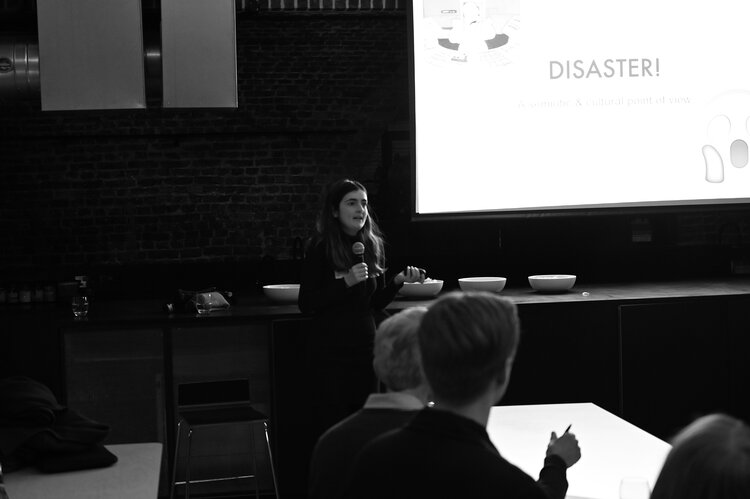
Our first speaker was Gemma Jones, a cultural strategist, speculative designer and co-founder of the School of Critical Design. Coming from a semiotician’s point of view that stories shape people, their behaviour and their responses to the world, Gemma talked about how meanings of “disaster” have moved from being seen as unpredictable “acts of god” to being man-made. “Hiroshima was a disaster,” she said, “but to the indigenous peoples of the Americas, so was the arrival of Europeans.”
While, to Gemma, “disaster” is the right word to use for the times we are living, our notion of “disaster-ness” needs to be adapted. Climate change is different in that it is a disaster that unfolds on a temporal scale we can’t see. Our usual fight-or-flight response, Gemma argued, wasn’t triggered because we didn’t have anyone or anything to fight, nor anywhere to run to—which left us in a paralysed state.
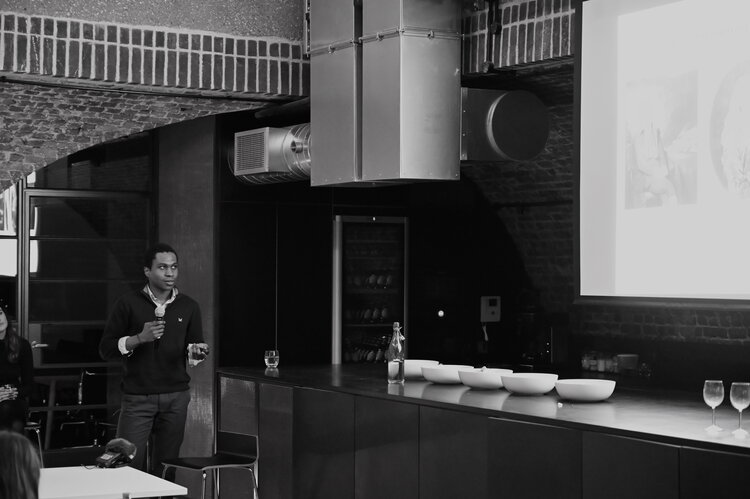
Noel Moka was our second speaker. A geographer studying anthropogenic change and a trustee at Participatory City, Noel also felt that our attitudes to disaster had changed over the course of history. From the age of Rationalism, he argued, natural catastrophes were no longer mysterious “acts of gods” but the understandable consequences of an event: a volcanic eruption was the result of geological movements; a flood, the result of an imbalance of in vs. outflow. The risk of disaster became calculable, could be observed and predicted to a large extent—and with this grew a belief that technology could prevent disaster. This had led to (Western) societies organising themselves around risk-response, in a process Noel called “reflexive modernisation”: technology and society would react to expected sporadic catastrophes.
However, Noel continued, “many of the current environmental risks are hardly calculable because we do not understand the consequences of our technological progress.” Rather than prevent disaster, this attitude had perpetuated it and created unforeseen events. Problem-solving kept creating new problems, Noel argued, and he traced this faith in technology back to an anthropocentric attitude, an Icarian hubris, that had disconnected us from our environment.

Paddy Loughman, a strategy director who is involved in Extinction Rebellion, added to this diagnosis by giving us facts and predictions that even at a conservative estimate were terrifying. He quoted James Baldwin to invoke courage and responsibility: “not everything that we face can be changed; but nothing can be changed without facing it.” XR’s fire alarm has been ringing long enough, the necessity to limit global warming to +1.5ºC vs. pre-industrial levels is known well enough for us not to reiterate it here. Nevertheless, a number that may have shocked many in a room full of place-makers, was that China had poured more concrete (one of the biggest sources of CO2) in the last three years than the US did throughout the twentieth century. This revealed deep flaws in a growth economy based on construction, but it also gave us an easy place-related solution: to rethink the materials we use. As Paddy said, the ecological crisis is not an incurable disease. “We know what to do, we just have to do it.”
“Treatment” — Mentality Shift
Our three speakers all agreed, a crucial step was to change our relationship to our environment. Paddy reminded us that “we are nature,” that we shared 25% of our genes with trees, that 50% of our genes weren’t human. Ecology, in his words, is not a commodity but our community. Noel similarly suggested adopting a nodal model of place in which the human and the non-human are connected in intricate ways, recognising the agency of all elements.
Changing our response to the “slow apocalypse,” according to Gemma, required us to promote narratives that made people “feel” the current disaster on a sensory, emotional level. This would allow us to tap into the mentality of mutual assistance, of creativity—of humanity—that is seen when large-scale catastrophes occur (like the 2004 tsunami in South-East Asia). To Paddy, this also meant understanding that climate change wasn’t the narrative itself but a setting for all other narratives, always present.
In this respect, we were encouraged to use narratives of the future as speculative design. While Paddy called for us to remember the power of hope and of promise, Gemma quoted Björk and her Cornucopia: “imagine a future … be in it.” In our fight-or-flight response, we need to give ourselves something to run towards. This future, echoing Kate Raworth’s Doughnut Economics, must fundamentally rethink our economy away from pure growth towards a model that factors in ecological ceilings. This, the room agreed, required us to look at value in a different way (“the financial value of ecology would be double global GDP”); to change the metrics we use to measure success in general, and in planning places specifically.
Actions In Place
Gemma’s wish, for instance, was that we thought of “places as spaces to prototype adaptive behaviour—as spaces for us to feel the new ways that we need to live in.” She went on, “what places can do is to create space for people to be that doesn’t require consumption, productivity, growth: that are just about dwelling, communicating.” Noel echoed this: “Places are not products, they are systems. Place-making’s role is to design community.” This is something Participatory City seeks to achieve through the involvement of residents—and we need more of that, to foster both responsibility and, perhaps, accountability.
In many ways, in spite of the gloomy nature of the theme, there was also a sense of optimism in the room; that it was possible to do something about the looming disaster; that “we are the leaders we’ve been waiting for,” as Paddy ended his talk: we have to go beyond pledges and commitments. It is in our hands to make plans for action.
Actions and plans were what we asked of everyone in the audience. One such could be to re-wild the city, which, numbers show, would be 40% more effective at absorbing CO2 than monocultures and lawns. Space for wildness in the city abounds, and residents could take more into their own hands—from rooftops to gardens to public squares.
Many of the plans our audience made centered around professional responsibility and agency. Specifically, they were plans to “Try to hold my boss accountable to his pledge — architects declare” and to “Challenge my own small business to lead by setting an example, challenging our clients and manufacturers.” One participant planned to “Devise new decision filters that at least manifest a fresh awareness,” while another wanted to “Be evidence-based and (…) to push developers and show them that innovation = value.” Such plans will require courage – and we wish them all the strength they need.
Still, many participants also made plans for individual action in their personal lives. These ranged from tangible things like “Invest in a good bike and use it”, “Fly less”, “Holiday at home” and “Create rituals and journeys that don’t involve consuming” to more ambitious mind-shifts: “Think, act and consume more locally (…) and give back to place – place is built by us committing to space.” As several people in the audience wrote, change will require us all to “Speak up, act up, act out of love not fear” but, most of all, “Show up”. We hope this will inspire you, too.
Written by Julien Clin.
Listen to the accompanying PlaceLabs Podcast.

